
The Pancha Bhoota Sthalams are five ancient temples in South India where Lord Shiva is worshipped as the five basic elements — Earth, Water, Fire, Air, and Space — that make up all creation. ‘Pancha’ means five, ‘Bhoota’ means element, and ‘Sthalams’ means sacred places. Each of these shrines is deeply intertwined with Shaiva mythology and represents a unique aspect of Shiva’s cosmic presence.
Four of the five temples are in Tamil Nadu, and one — the Vayu Sthalab at Srikalahasti — is in Andhra Pradesh. Completing a pilgrimage to all five is considered an act of profound spiritual significance. Each temple has a distinct legendary narrative, a unique feature of the Shivalinga (some are naturally formed, some always moist, one has a constantly flickering flame), and a rich architectural heritage spanning the Pallava, Chola, Vijayanagara, and Nayak periods.
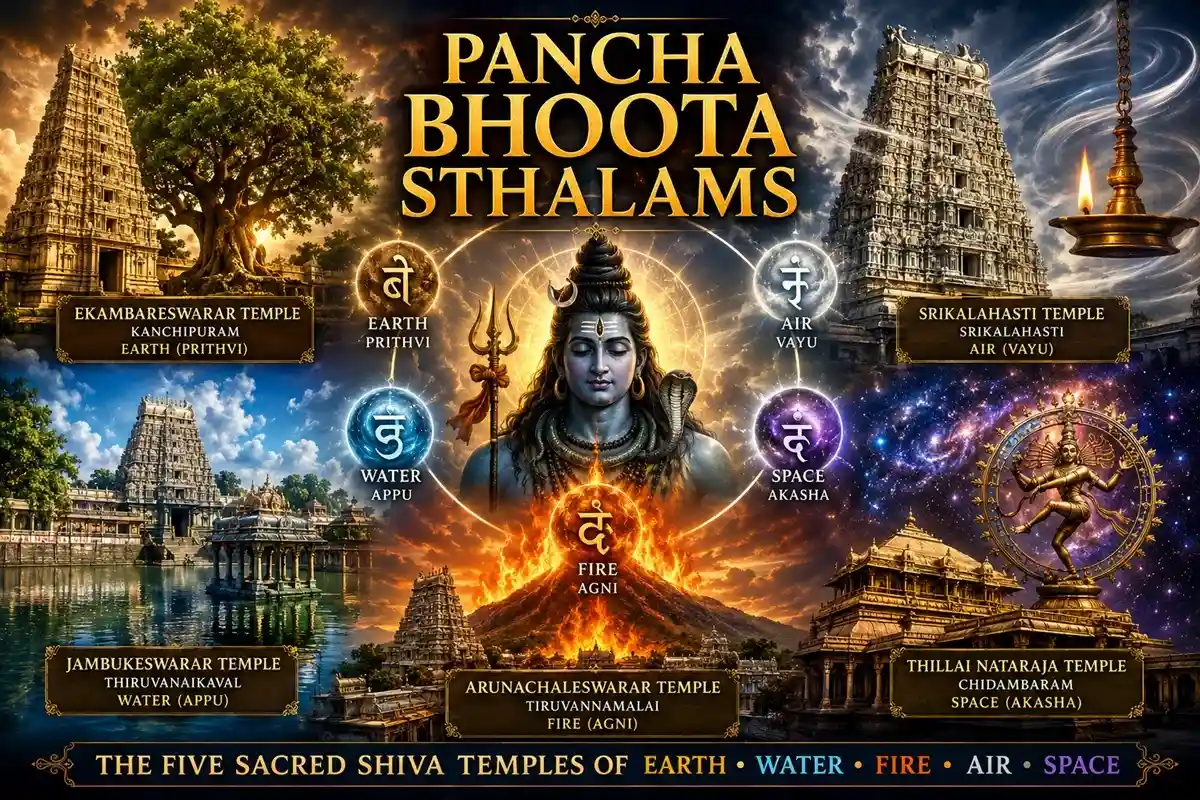
Pancha Bhoota Sthalams — At a Glance
- Ekambareswarar Temple – Earth (Prithvi) | 6 AM–12 PM, 4 PM–8:30 PM
- Jambukeswarar Temple – Water (Appu) | 5:30 AM–1 PM, 3 PM–8:30 PM
- Arunachaleswarar Temple – Fire (Agni) | 5:30 AM–12:30 PM, 4 PM–9:30 PM
- Srikalahasteeswara Temple – Air (Vayu) | 6 AM–1 PM, 2 PM–9 PM
- Thillai Nataraja Temple – Space (Akasha) | 6 AM–12:30 PM, 4:30 PM–9 PM
Entry: Free | Special Darshan: Available at counters
Circuit Duration: 5–7 days
Best Base Cities: Chennai, Tiruchirappalli (Trichy), Tirupati.
History of the Pancha Bhoota Sthalams
The concept of Pancha Bhoota Sthalams draws from the Shaiva Siddhanta philosophy, which holds that Lord Shiva manifests in and through the five elements of creation. The origins of this pilgrimage circuit are rooted in ancient Tamil Shaiva literature — particularly the Thirumurai, a collection of 12 volumes of Shaiva devotional hymns composed by the Nayanmars (Tamil Shaiva saints) between the 6th and 9th centuries CE.
The saint-poet Thirunavukkarasar (Appar), in his Devara hymns, explicitly references the Shivalingas at each of these five locations as representing the cosmic elements. His compositions — along with those of Thirugnana Sambandar and Manikkavasagar — are still recited during daily temple rituals at all five shrines. The temples themselves were built or substantially expanded by the Pallava, Chola, Vijayanagara, and Nayak dynasties, whose patronage shaped the towering gopurams and the vast temple complexes visible today.
All Five Pancha Bhoota Sthalams — Quick Reference 2026
| Temple | Location | Element | Deity Form | Darshan Timings | Nearest City |
| Ekambareswarar | Kanchipuram, Tamil Nadu | Earth (Prithvi) | Prithvi Lingam (sand) | 6 AM–12 PM | 4 PM–8:30 PM | Chennai (75 km) |
| Jambukeswarar | Thiruvanaikaval, Tamil Nadu | Water (Appu) | Appu Lingam (spring-fed) | 5:30 AM–1 PM | 3 PM–8:30 PM | Trichy (6 km) |
| Arunachaleswarar | Tiruvannamalai, Tamil Nadu | Fire (Agni) | Agni Lingam (pillar of light) | 5:30 AM–12:30 PM | 4 PM–9:30 PM | Vellore (75 km) |
| Srikalahasteeswara | Srikalahasti, Andhra Pradesh | Air (Vayu) | Vayu Lingam (flame flickers) | 6 AM–1 PM | 2 PM–9 PM | Tirupati (36 km) |
| Thillai Nataraja | Chidambaram, Tamil Nadu | Space (Akasha) | Akasha Lingam (formless) | 6 AM–12:30 PM | 4:30 PM–9 PM | Cuddalore (58 km) |
1. Ekambareswarar Temple, Kanchipuram — Earth (Prithvi)
The Ekambareswarar Temple in Kanchipuram, Tamil Nadu, represents the earth element. The Shivalinga here is known as the Prithvi Lingam — a naturally formed sand lingam (Swayambhu) that is believed to be self-manifested and over 3,500 years old. According to the legend connected to this temple, Goddess Parvati performed intense penance here under a single mango tree to reunite with Lord Shiva. To test her devotion, Shiva sent a great flood and fire to disturb her. She embraced the lingam tightly to protect it. Pleased with her devotion, Shiva appeared before her and made her a part of him. The ancient mango tree under which this penance took place still stands in the temple complex — believed to be over 3,500 years old, it bears four different varieties of mango on its four branches, one for each of the four Vedas.
The temple complex covers 25 acres and features the magnificent Rajagopuram — one of the tallest temple towers in India at 59 metres. The Thousand-Pillared Hall (Aayiram Kaal Mandapam) is an architectural masterpiece with intricately carved pillars. Since the Prithvi Lingam is made of earth (sand), no water abhishekam is performed on it — only flower and fruit offerings.
- Element: Earth (Prithvi) | Deity: Ekambareswarar (Shiva) + Kamakshi Amman
- Timings: 6:00 AM – 12:00 PM | 4:00 PM – 8:30 PM | Verify on festival days
- Entry: Free | Special puja: On-site counter | No advance online booking as of 2026
- Men must remove shirt before entering the garbhagriha | Traditional dress required
- Do not miss: 3,500-year-old mango tree with four varieties | Rajagopuram (59 m) | Thousand Pillars Hall
- Nearest railway: Kanchipuram station (2 km) | Nearest airport: Chennai (75 km)
2. Jambukeswarar Temple, Thiruvanaikaval — Water (Appu)
The Jambukeswarar Temple at Thiruvanaikaval (near Trichy) represents the water element. The Shivalinga here — called the Appu Lingam — stands in a natural underground spring inside the sanctum. The sanctum floor is perpetually damp, and the spring water level rises and falls with the seasons — a natural phenomenon that has never been altered or artificially controlled in the thousands of years since the temple was built. This is the physical manifestation of Shiva as water itself.
The temple was constructed approximately 1,800 years ago by the Chola king Kochengatkanan Chola. According to legend, Goddess Parvati (here worshipped as Akilandeswari — the goddess of the universe) fashioned a Shivalinga from sand and water of the Cauvery river and performed penance under a Jambu (naaval/blackberry) tree. Impressed by her devotion, Lord Shiva accepted her as his student and taught her the Pranava Mantra (OM). One of the most distinctive rituals at this temple is the noon puja, where a male priest dresses in traditional female attire (saree) and worships both Lord Jambukeswarar and a special black cow called ‘Karum Pasu’ — commemorating a significant mythological event associated with this temple.
- Element: Water (Appu/Jalam) | Deity: Jambukeswarar (Shiva) + Akilandeswari
- Timings: 5:30 AM – 1:00 PM | 3:00 PM – 8:30 PM
- Entry: Free | Darshan: 15–20 min weekdays | 30–40 min weekends
- Free lunch (prasad): Served daily at 12:00 PM to 100 devotees
- Unique ritual: Male priest dresses as Goddess at 12:30 PM noon puja — deeply significant
- Nearest: Trichy Junction railway station (8 km) | Tiruchirappalli Airport (12 km)
3. Arunachaleswarar Temple, Tiruvannamalai — Fire (Agni)
The Arunachaleswarar Temple at Tiruvannamalai represents the fire element. Unlike the other four temples where the Shivalinga has a physical form, the Agni Lingam at Tiruvannamalai is considered to be an endless column of fire — Jyothi or the flame of consciousness. According to the Shaiva Purana, Lord Shiva appeared here as an infinite column of fire to settle a dispute between Lord Brahma and Lord Vishnu, each of whom claimed to be the Supreme Being. Neither could find the top or bottom of the pillar — and in that act of humility, both recognized Shiva as the source of all.
The Annamalai Hill behind the temple is itself considered a form of Shiva — a sacred hill of fire energy. Devotees walk around the base of this hill in a practice called Girivalam (circumambulation), which covers approximately 14 km. Girivalam is considered especially sacred on full moon days (Pournami), when hundreds of thousands of pilgrims walk the route through the night. The Karthigai Deepam festival (November–December) is the most spectacular event here — a giant lamp is lit on the summit of Annamalai Hill, visible for miles across the plains.
- Element: Fire (Agni/Tejo) | Deity: Arunachaleswarar + Unnamalai Amman
- Timings: 5:30 AM – 12:30 PM | 4:00 PM – 9:30 PM (extended during festivals)
- Entry: Free | VIP darshan available | Booking via official temple portal or counter
- Girivalam (hill circumambulation): 14 km | Especially on full moon days
- Temple spread: 25 acres | One of the largest temple complexes in Tamil Nadu
- Nearest: Tiruvannamalai railway station (1.5 km) | Chennai (160 km)
4. Srikalahasteeswara Temple, Srikalahasti — Air (Vayu)
The Srikalahasteeswara Temple at Srikalahasti in Andhra Pradesh represents the air element. The physical proof of Shiva’s presence as air here is extraordinary: a flame lamp inside the sanctum — despite being completely enclosed — constantly flickers, as if moved by an unseen wind. No draft is present, no ventilation exists, and no one can explain the movement of the flame through scientific means. This flickering lamp is the visible sign of the Vayu Lingam.
The temple is equally famous as the foremost center for Rahu-Ketu Sarpa Dosha Nivarana Puja — a powerful astrological remedy for those afflicted by the malefic influence of the shadow planets Rahu and Ketu. Thousands of devotees visit specifically for this puja, which is performed here with a unique ritualistic authority not found at other temples. The temple is also known as ‘Dakshina Kailasam’ (the Kailash of the South). The story of Bhakta Kannappa — a hunter-devotee who offered his own eyes to Lord Shiva in an ultimate act of devotion — is deeply associated with this temple.
- Element: Air (Vayu) | Deity: Srikalahasteeswara (Shiva) + Gnana Prasunamba
- Timings: 6:00 AM – 1:00 PM | 2:00 PM – 9:00 PM
- Entry: Free | Rahu-Ketu Sarpa Dosha puja: booking at counter or via temple website
- Peak days: Saturdays + Amavasya — very heavy crowds | Avoid for peaceful darshan
- Unique: The flame in the sealed sanctum flickers — physical sign of Vayu Lingam
- Location: 36 km from Tirupati | Tirupati Airport is the nearest airport
Suggested Tour: Andhra Pradesh Tour Packages
5. Thillai Nataraja Temple, Chidambaram — Space/Ether (Akasha)
The Thillai Nataraja Temple at Chidambaram represents the space element — Akasha or Ether. This is conceptually the most abstract of the five, and therefore the most philosophically significant. The presiding deity here is not just the Shivalinga but Lord Shiva as Nataraja — the cosmic dancer — whose dance of creation, preservation, and destruction encompasses all of space and time. The Akasha Lingam here is unique: it is formless, invisible — represented by the empty space (Chidambara Rahasyam) behind a curtain of golden vilva leaves in the inner sanctum. When this curtain is drawn aside, devotees see empty space — and this emptiness itself is the divine.
The Chidambaram Rahasyam (secret of Chidambaram) is one of the most profound concepts in Hindu philosophy: God is present in the void, in emptiness, in consciousness itself. The temple complex is maintained by hereditary priests (Dikshitars) — a unique lineage distinct from the standard temple administration. The architecture is a blend of Pallava, Chola, Pandya, and Vijayanagara styles. The 135-foot east gopuram is decorated with 108 karanas — dance postures of Bharatanatyam — linking this temple to classical Indian dance.
- Element: Space/Ether (Akasha) | Deity: Nataraja (Shiva as Cosmic Dancer) + Sivakami Amman
- Timings: 6:00 AM – 12:30 PM | 4:30 PM – 9:00 PM
- Entry: Free | No special ticket for general darshan
- The ‘Chidambara Rahasyam’ — the curtain reveals empty space as the deity — is opened during special pujas
- 108 Karanas of Bharatanatyam carved on the east gopuram — a unique cultural heritage
- Nearest: Chidambaram railway station (1 km) | Cuddalore (58 km)
Suggested Tour: Tamil Nadu Tour Packages
Pancha Bhoota Sthalams — Darshan Timings 2026
All five temples offer free general darshan. Timings are subject to change on festival days — always verify with the temple before visiting.
| Temple | Morning Darshan | Evening Darshan | Midday Closure |
| Ekambareswarar (Kanchipuram) | 6:00 AM – 12:00 PM | 4:00 PM – 8:30 PM | 12:00 PM – 4:00 PM |
| Jambukeswarar (Thiruvanaikaval) | 5:30 AM – 1:00 PM | 3:00 PM – 8:30 PM | 1:00 PM – 3:00 PM |
| Arunachaleswarar (Tiruvannamalai) | 5:30 AM – 12:30 PM | 4:00 PM – 9:30 PM | 12:30 PM – 4:00 PM |
| Srikalahasteeswara (Srikalahasti) | 6:00 AM – 1:00 PM | 2:00 PM – 9:00 PM | 1:00 PM – 2:00 PM |
| Thillai Nataraja (Chidambaram) | 6:00 AM – 12:30 PM | 4:30 PM – 9:00 PM | 12:30 PM – 4:30 PM |
| Note: Temple timings may vary on festival days, Pradosham, Pournami (full moon), Amavasya, and during major events like Karthigai Deepam (Tiruvannamalai) and Arudra Darshan (Chidambaram). Always verify current timings with the respective temple administration before planning your visit. |
How to Plan the Pancha Bhoota Sthalams Pilgrimage
The Pancha Bhoota Sthalams are spread across Tamil Nadu and Andhra Pradesh. Four of the five — Kanchipuram, Thiruvanaikaval, Tiruvannamalai, and Chidambaram — are in Tamil Nadu. Srikalahasti is in Andhra Pradesh. A well-planned circuit can cover all five in 5–7 days.
| Day | Temple | Distance from Previous | Suggested Base |
| Day 1 | Srikalahasti (Vayu) | Starting point | fly to Tirupati | Tirupati / Srikalahasti |
| Day 2 | Ekambareswarar, Kanchipuram (Prithvi) | ~140 km from Tirupati | Kanchipuram / Chennai |
| Day 3 | Arunachaleswarar, Tiruvannamalai (Agni) | ~80 km from Kanchipuram | Tiruvannamalai |
| Day 4 | Jambukeswarar, Thiruvanaikaval (Appu) | ~130 km from Tiruvannamalai | Trichy / Srirangam |
| Day 5 | Thillai Nataraja, Chidambaram (Akasha) | ~100 km from Trichy | Chidambaram |
Chennai and Trichy are the most practical base airports for this circuit. Chennai connects well to Kanchipuram (75 km) and Tiruvannamalai (160 km). Trichy connects well to Thiruvanaikaval (6 km) and Chidambaram (100 km). Tirupati airport or railway station is the entry point for Srikalahasti (36 km away).
Best Time to Visit the Pancha Bhoota Sthalams
| Season | Months | Conditions | Verdict |
| Winter | October – February | Cool, pleasant (22–30°C) | Best — ideal for walking circuits, Karthigai Deepam in Nov/Dec at Tiruvannamalai |
| Spring | March – May | Warm to hot (28–38°C) | Good — Brahmotsavams at several temples |
| Monsoon | June – September | Rain, humidity (25–32°C) | Manageable — fewer crowds but some flooding near river temples |
- Karthigai Deepam (November/December): The biggest festival at Tiruvannamalai — a giant lamp on Annamalai Hill summit. Millions attend. Plan months in advance.
- Arudra Darshan (December/January): The most sacred day at Chidambaram Nataraja Temple — the cosmic dance of Shiva is celebrated. Very large crowds.
- Maha Shivratri (February/March): All five temples observe this festival with special pujas and extended timings. Srikalahasti sees extremely large crowds.
- Full moon days (Pournami): Girivalam (hill circumambulation) at Tiruvannamalai draws up to 3 lakh pilgrims on Pournami nights.
Practical Tips for Pancha Bhoota Sthalams Pilgrimage
- Dress code: Traditional Indian attire is required at all five temples. Men must often remove their shirt (bare chest) before entering the innermost sanctum. Women must wear saree, salwar kameez, or half-saree.
- Footwear: Remove shoes at the temple entrance. Paid shoe-keeping counters are available at all five temples.
- Photography: Check rules at each temple — restrictions vary. Photography inside sanctums is generally not permitted.
- Entry fees: All five temples offer free general darshan. Special pujas (Rudrabhishek, Abhishekam, Rahu-Ketu puja at Srikalahasti) are available for a fee at the temple counter.
- Best darshan time: Arrive at opening time (5:30–6:00 AM) for the most peaceful experience with shortest queues.
- Language: Telugu at Srikalahasti; Tamil at all four Tamil Nadu temples. Priests communicate in the local language for puja guidance — a guide or translator is helpful for first-time visitors from non-Tamil/Telugu speaking states.
- Mobile networks: Good connectivity at all five locations. Google Maps works reliably for navigation between these temples.
Frequently Asked Questions
Q1. What are the Pancha Bhoota Sthalams?
Pancha Bhoota Sthalams are five ancient Shiva temples in South India — four in Tamil Nadu and one in Andhra Pradesh — where Lord Shiva is worshipped as the five primordial elements: Earth (Prithvi) at Ekambareswarar Temple, Kanchipuram; Water (Appu) at Jambukeswarar Temple, Thiruvanaikaval; Fire (Agni) at Arunachaleswarar Temple, Tiruvannamalai; Air (Vayu) at Srikalahasteeswara Temple, Srikalahasti; and Space (Akasha) at Thillai Nataraja Temple, Chidambaram.
Q2. Why are the Pancha Bhoota Sthalams important?
These five temples are sacred because Lord Shiva is believed to be present as the five elements themselves — not just a deity in a stone form, but as the fundamental forces of nature. Completing a pilgrimage to all five is considered an act of cosmic completion, bringing the devotee into harmony with all five elements of creation. The concept is rooted in the Shaiva Siddhanta philosophy and references in the ancient Tamil Thirumurai hymns.
Q3. What is the significance of each Pancha Bhoota Sthalab?
Each temple embodies one element: Ekambareswarar (earth) has a sand Shivalinga and a 3,500-year-old mango tree. Jambukeswarar (water) has an ever-moist Appu Lingam fed by underground springs. Arunachaleswarar (fire) represents the infinite column of light where Shiva appeared to end a cosmic dispute. Srikalahasti (air) has a flame that flickers mysteriously in a fully enclosed sanctum. Chidambaram (space) has the formless Akasha Lingam — empty space itself as the divine presence.
Q4. How can you reach all Pancha Bhoota Sthalams?
A well-planned 5–7 day circuit works best. Start from Srikalahasti (fly to Tirupati), then Kanchipuram (~140 km, via Chennai), Tiruvannamalai (~80 km), Thiruvanaikaval/Trichy (~130 km), and finally Chidambaram (~100 km). Chennai, Trichy, and Tirupati are the three main airports serving this circuit. Tamil Nadu has good road connectivity between all four Tamil Nadu temples.
Q5. What is special about the Srikalahasti Temple?
Srikalahasti is the only Pancha Bhoota Sthalab outside Tamil Nadu — in Andhra Pradesh, 36 km from Tirupati. The Vayu (Air) Lingam here has a flame inside the sealed sanctum that flickers continuously despite the absence of any visible source of air — one of the most powerful physical manifestations of the divine element in any of the five temples. The temple is also the foremost center in South India for Rahu-Ketu Sarpa Dosha Nivarana Puja.
Q6. What is the dress code for visiting these temples?
Traditional Indian attire is required at all five temples. Men must wear dhoti or traditional pants and remove their shirt before entering the innermost garbhagriha (sanctum). Women should wear saree, salwar kameez, or half-saree. Shorts, sleeveless tops, and Western casual clothing are not permitted inside the temple premises.
Q7. Can non-Hindus visit the Pancha Bhoota Sthalams?
Jambukeswarar and Arunachaleswarar temples are generally open to all visitors. Ekambareswarar and Srikalahasti have their own guidelines. Thillai Nataraja Temple at Chidambaram has historically restricted entry to the innermost sanctum to Hindus. Practices may vary — check current guidelines with the respective temple administration before visiting.
Q8. What is the entry fee for Pancha Bhoota Sthalams?
General darshan is free at all five Pancha Bhoota Sthalams. Special pujas — such as Rudrabhishekam, Abhishekam, and the Rahu-Ketu puja at Srikalahasti — are available for a nominal fee at the temple ticket counter. No advance online booking is required for general entry at most of these temples. Check individual temple websites for current special darshan fees.

 Call
Call Enquiry